Scapular protraction: 4 exercises for a better planche
Scapular protraction means bringing your shoulder blades forward and rounding your upper back a little. To do it properly, do four things at once: shoulders up, forward, down, then push with your serratus. Train it standing first, then in the planche lean, then with tuck planche resets: 3 sets of 3 holds of 3 seconds.
After seven years of training, I think I finally found the cheat code to the planche. Not just the planche: protraction, which you need in a lot of calisthenics exercises.
I had very bad protraction when I started, like almost everyone. Now it is definitely there, and I know exactly what I am doing in each exercise to get it. I always hated it when people say they found the one cheat code. So here is the knowledge and experience instead, so you can try it yourself.
It works for the planche, for the handstand push-up and for almost every hollow body hold position.
What is scapular protraction?
Protraction is getting your shoulder blades in front and rounding your back a little bit. Your shoulder blades slide forward around your ribs, away from your spine. The opposite is retraction: squeezing them together behind you.
Everyone wants perfect protraction, but almost nobody actually knows how to get it. The usual cue is "shoulders forward and down". Do only that and you get a weak version of the position. A few small changes make a big difference, both in how the position looks and in how strong you are in it.
Why does protraction matter for the planche?
Without it, your upper back caves in and your shoulders sink between your arms. With it, your upper back stays round, your shoulders push away from the floor and your body has a solid base to lean on.
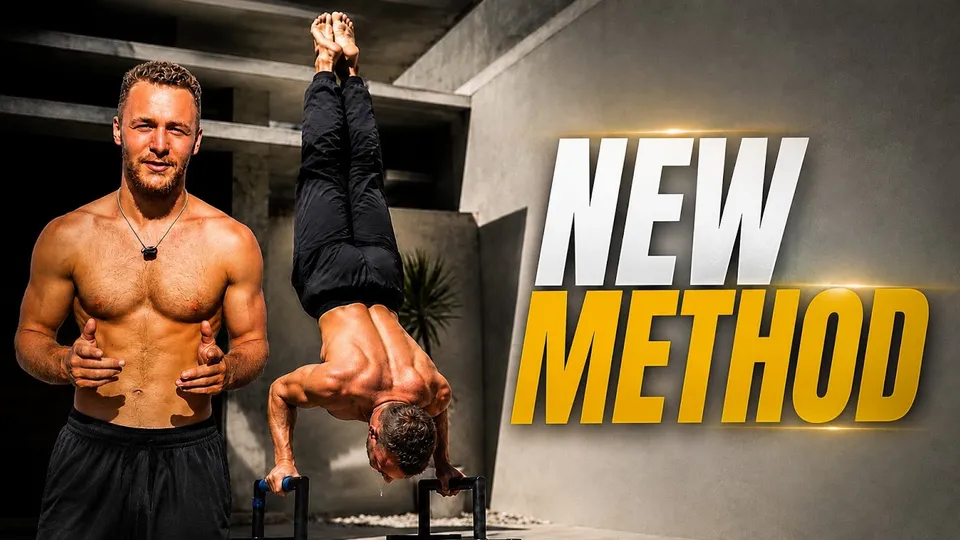
You can see the same difference in the handstand: the same body, a completely different position, just from using protraction.
Most people I see in a planche are doing it without protraction. That is the part that holds them back, not their strength.
How do you protract your shoulder blades properly?
Four movements, all at the same time:
- Up. Lift your shoulders towards your ears.
- Forward. Bring them forward.
- Down. Push them down, away from your ears.
- Serratus. Push your shoulder blades forward and around with your serratus, the muscle on the side of your ribs under your armpit.
Then switch on your core, because that is very important in the planche. Up, forward, down, serratus, core. Bam: that is your position.
What are the best scapular protraction exercises?
Four exercises plus a bonus, in this order. Each one makes the position harder to keep.
| # | Exercise | What it trains |
|---|---|---|
| 1 | Standing protraction | Finding the position at all |
| 2 | Plank to planche lean | Keeping it while you lean |
| 3 | Scapular movements in the planche lean | Moving one direction at a time |
| 4 | Tuck planche resets | Getting strong in perfect form |
| Bonus | Banded planche | Perfect form only, in the full skill |
1. Standing protraction
Stand in front of a mirror. Go up, forward, down, use your serratus, and hold that position.
It sounds too simple, but it is the test for everything after it. If you cannot do it well standing, you will most definitely not get it in a planche lean.
2. Plank to planche lean
- Grab your parallettes on the back of the bars and squeeze them firmly.
- Without leaning yet, get into a plank position.
- Do the same thing: up, forward, down, serratus and core.
- Now start leaning forward.
Actively push back into the ground the whole time. This is where most people lose it. They get into the position perfectly, and as soon as they lean, it is gone, because they stopped pushing and stopped trying to keep it.
If the planche lean is new to you, calisthenics for beginners shows where it fits in your first weeks of training.
3. Scapular movements in the planche lean
Still in a planche lean, because it is a really controlled position. But now you are elevated, in the perfect planche alignment.
From there, go to the wrong position and back to the right one. Wrong, right. Wrong, right. Move in one direction at a time, not all at once.
- Protraction and retraction. Keep your shoulders down, then go retraction, protraction, retraction, protraction.
- Elevation and depression. Keep your serratus and your protraction, then go shoulders up, down, up, down.
This is where the mind-muscle connection comes from. I looked at myself in the mirror and tried to switch this on for seven years before I figured it out. Now I can move my shoulder blades completely freely, in any direction. Once you truly understand your body, you can do crazy things with it.
4. Tuck planche resets
My all-time favourite.
Most people hold their planche until they get tired, and then keep holding it in bad form to get more volume in. Resets do the opposite: you come out as soon as your form is not perfect anymore. You want to get stronger in the right position, so you train in the right position. Sounds logical, right?
- Go up, forward, down and use your serratus.
- Go into the tuck planche and hold it for about 3 seconds.
- Come out, set up the perfect position again, and hold again.
- One more time.
I do 3 sets of 3 resets of 3 seconds. Three, three, three. You can add sets, or hold longer: 2 resets of 6 seconds each also works.
I am doing them in tuck, but it is the exact same in the advanced tuck, straddle, half lay or any other progression.
Bonus: banded planche, perfect form only
Do the planche in a resistance band, but only with perfect form. Get into the correct position, lean, and lift your legs from the lean.
This is form training, not strength training. If you cannot do it with perfect form, go one progression back or use a heavier band.
Where else do you need protraction?
Almost every pushing skill where your body is straight and your arms are locked.
- The planche and every step towards it, from the planche lean to the full planche.
- The handstand and handstand push-up. Protraction pushes you away from the floor. More on that in how to do a handstand push-up.
- Hollow body holds. The same rounded upper back, the same serratus.
What are the most common protraction mistakes?
- Only going "forward and down". You miss the up and the serratus, and the position stays weak.
- Skipping the standing version. If you cannot find it standing, you will not find it in a lean.
- Stopping the push when you lean. The position disappears the moment you stop pushing into the ground.
- Moving everything at once in the drills. One direction at a time, or you do not learn to control any of them.
- Holding the planche in bad form for volume. Use resets. Come out when your form breaks and go back in.
Scapular protraction FAQ
What muscle does scapular protraction?
Mainly the serratus, the muscle along the side of your ribs. It pushes your shoulder blades forward around your ribcage. In the planche, your core works with it to keep your body in one line.
How do you fix bad protraction?
Start standing in front of a mirror: up, forward, down, serratus, and hold it. Then take it into a plank and a planche lean while you keep pushing into the ground. Almost everyone starts with bad protraction. It is a skill you learn, not something you have or do not have.
What is the difference between protraction and retraction?
Protraction brings your shoulder blades forward and apart. Retraction pulls them back and together. The planche and the handstand push-up need protraction. Pulling skills like the front lever need retraction.
How many sets and reps for planche resets?
3 sets of 3 resets of 3 seconds is where I start. You can do more sets, or 2 resets of 6 seconds. Come out of every hold as soon as your form is not perfect.
Where do you go from here?
Start in front of the mirror today. Up, forward, down, serratus. When you can hold it standing, take it into the planche lean and keep pushing.
I wish I had this when I started calisthenics. Protraction is what makes the planche look right, and what makes it stronger. If you want to see which skills use it next, calisthenics skills ranked lists the order I would train them in. And if you would rather not plan each session yourself, CaliRealm builds that plan for you and moves you up when you are ready.