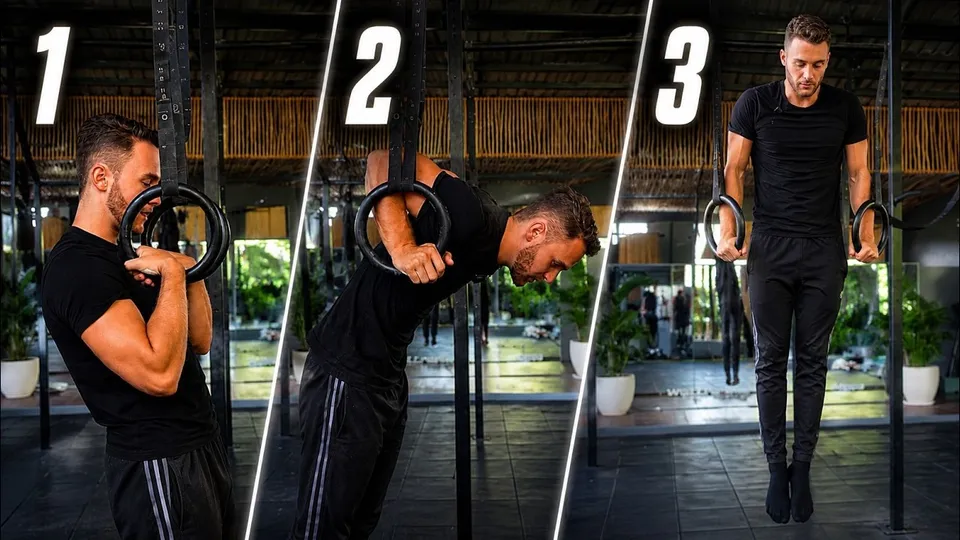
How to do a muscle-up: timing, not more pull-ups
To do a muscle-up you need a small hollow swing, an explosive pull just after the front dead point, and enough straight-bar dip strength to press out on top. You do not need more pull-ups. I got my first muscle-up with a four pull-up max, because the muscle-up is a timing problem before it is a strength problem.
Most people chasing their first one train the wrong thing. They add pull-ups. More pull-ups, better pull-ups, weighted pull-ups, on the theory that somewhere around rep fifteen the muscle-up appears.
It does not work like that. Here is the whole movement, broken into the six pieces you actually train.
Why won't more pull-ups give you a muscle-up?
Because a pull-up and a muscle-up point their force in different directions.
Picture the bar. Picture yourself hanging under it. You want to end up on top of it. Now pull straight up, as hard as you can. You hit the bar. It does not matter how explosive you are, there is no path from under to over if your only force points up. The bar is in the way.
So something else has to happen. You need a second force: a swing. One vector pulls you up, one carries you back, and the result takes you around the bar instead of into it. Basic vector addition, the same diagram from physics class.
The important detail: the pull has to be bigger than the swing. The swing redirects you. The pull does the work. People who get this backwards end up kicking hard and going nowhere.
When in the swing should you pull?
Just after the front dead point, at the instant you start swinging back.
You have two dead points. One at the front, where you have stopped going forward but have not started coming back, and its mirror at the rear. At the front dead point you are, for a fraction of a second, going nowhere.
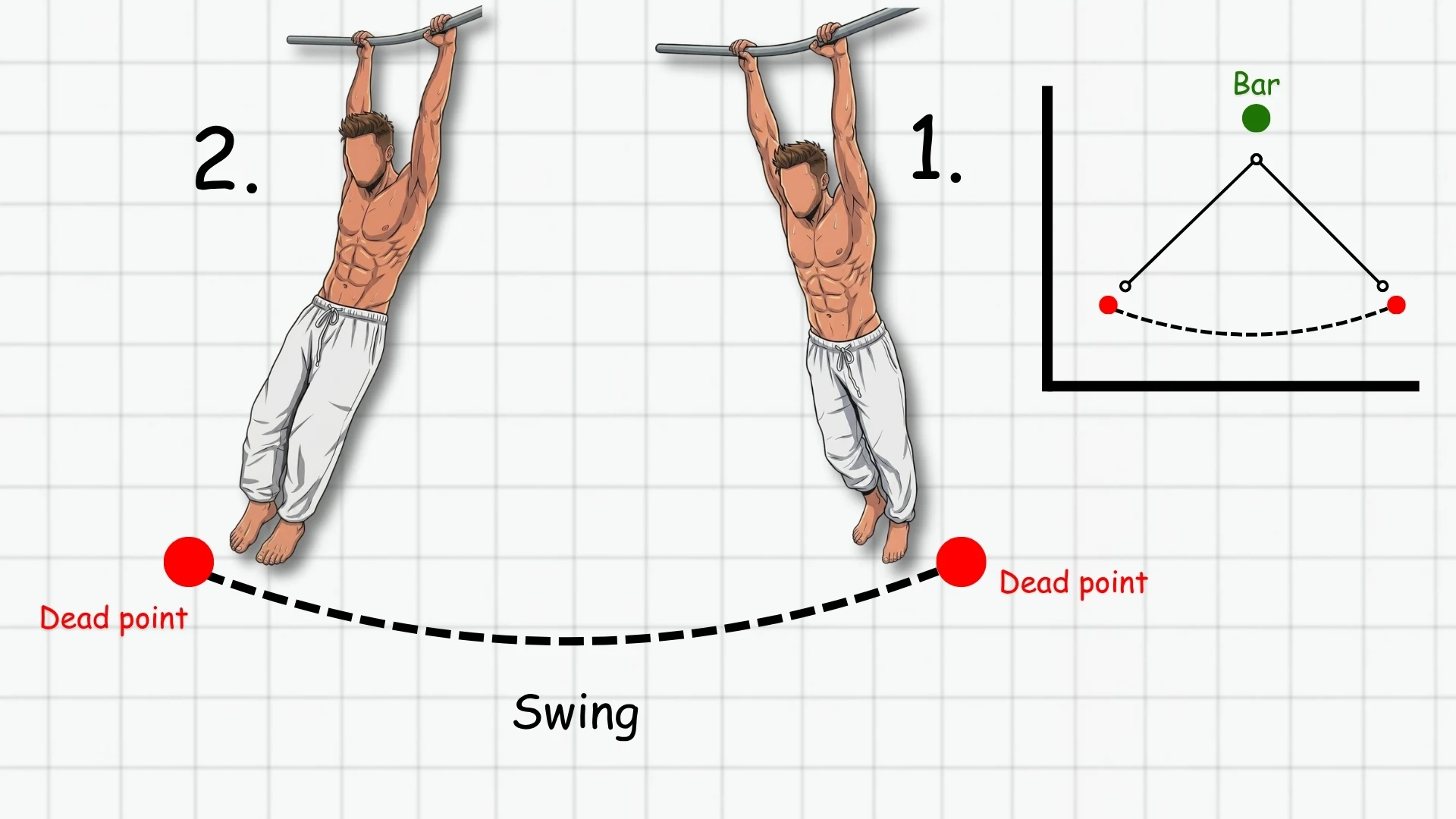
The two dead points. At each end of the arc you are, for an instant, going nowhere.
Most people pull at the front dead point, or on the way out to it. That is too early. Your legs are still travelling forward, so the pull sends you forward and away from the bar rather than over it. If you keep finishing your attempts out in front of the bar, this is why.
The moment you want is the one immediately after. Front dead point, and now you pull. That is when your momentum is already heading in a direction that helps you.
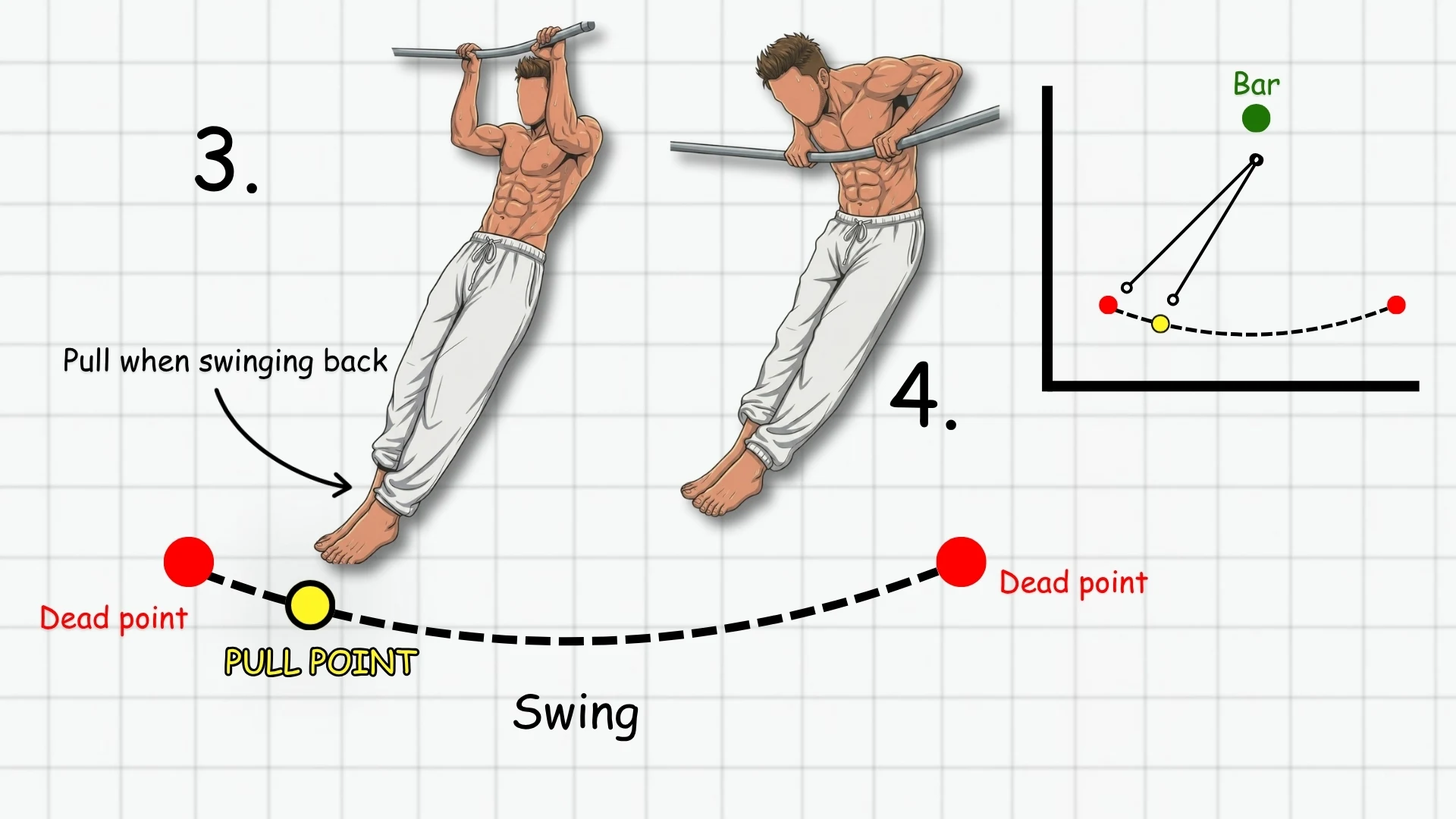
The pull point sits just after the front dead point, once you are swinging back.
Practise it with nothing but a swing and a call in your head: "now. now. now." Get the timing before you get the strength.
What are the six parts of a muscle-up?
The other reason people stall is that they treat the muscle-up as one movement. It is not. It is six, and they are trained separately.
| # | Part | What it trains | Move on when |
|---|---|---|---|
| 1 | Overgrip hang | Grip position before you pull | The grip sets itself without thinking |
| 2 | Hollow swing | A small, controlled swing | You can feel the front dead point |
| 3 | Explosive hollow pull-up | Height and speed | You pull to sternum height |
| 4 | Transition | Getting from pull to press | You can lower slowly under control |
| 5 | Straight-bar dip | Pressing out on top of the bar | 5 clean reps |
| 6 | Controlled descent | Coming back down safely | Every rep lands quiet |
1. Set an overgrip before you hang
Do not hang with a neutral grip that leaves your wrists under the bar. Roll into a bit of overgrip before you start, knuckles more over the top.
Why it matters: from a normal grip you have to rotate the entire wrist around the bar mid-movement, at exactly the moment you have the least control. From an overgrip you are already most of the way there, and getting your elbows over the bar becomes a small adjustment instead of a scramble.
Set the grip first. Every rep.
2. Swing from a hollow body
Do not try to hang perfectly still and then generate a swing from nothing. It is possible, but why make it hard?
Find a bar you can reach standing, or better, a slightly higher one you can just about hold. Grab it, take one step back, and let go into a hollow body position. The swing is already there.
And keep it hollow. Not arched, not knees tucked, not kicking, a hollow body hold that travels back and forth. If you do not know what a hollow body feels like, get on the floor and learn it there first. It shows up again in the handstand, the planche, the front lever and the back lever. It is not optional equipment.
Small swings. You are not chasing maximum amplitude, you are finding the moment.
3. The explosive hollow pull-up
There are two pull-ups. The arched one, chest open and chin to bar, is the one you see most often, and it is not the one you want here. The muscle-up pull-up is hollow.
So: overgrip, small swing, and at the moment just past the front dead point, an explosive hollow pull. Not a muscle-up attempt. Just pull as high as you can, as fast as you can.
If "as high as you can" is chest height, that is fine. You are still training the exact thing you need.
4. The transition
This is where everyone gets stuck, and there is an obvious reason: you never do this anywhere else. Where in your life do you produce force from the bottom of a straight-bar dip? Nowhere. A triceps pushdown is not the same movement, whatever it looks like on paper.
So use momentum to get through it. That is completely legitimate as a beginner. My first muscle-up used a knee drive and looked ridiculous, and it was still a muscle-up.
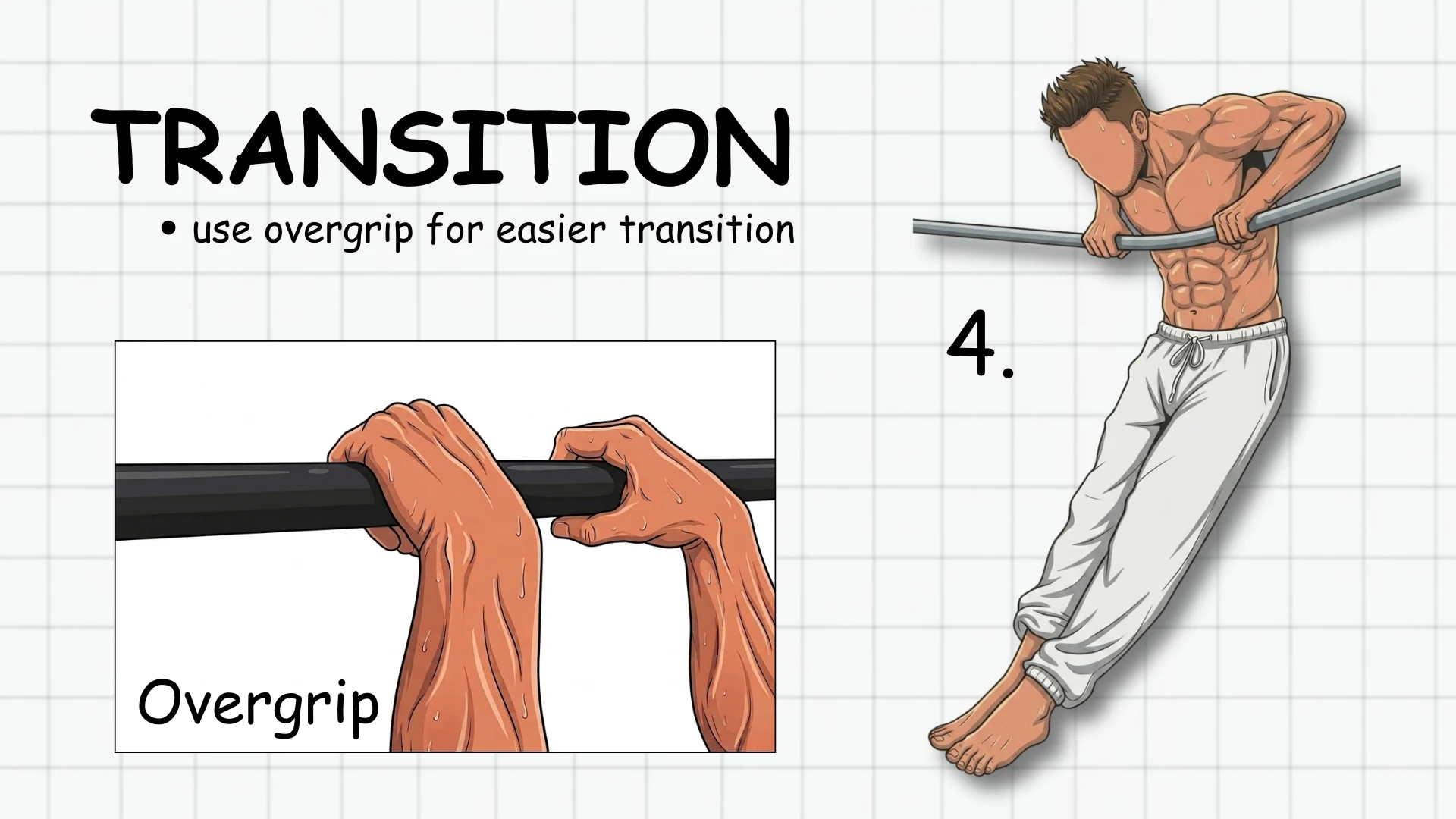
An overgrip set before the hang makes the transition a small adjustment instead of a scramble.
To get stronger there, use negatives, the same answer as everywhere else in calisthenics. Cannot do a push-up? Negatives. Cannot do a pull-up? Negatives. Cannot do a muscle-up? Negatives.
5. The straight-bar dip
Lie with your chest on top of the bar, then press out.
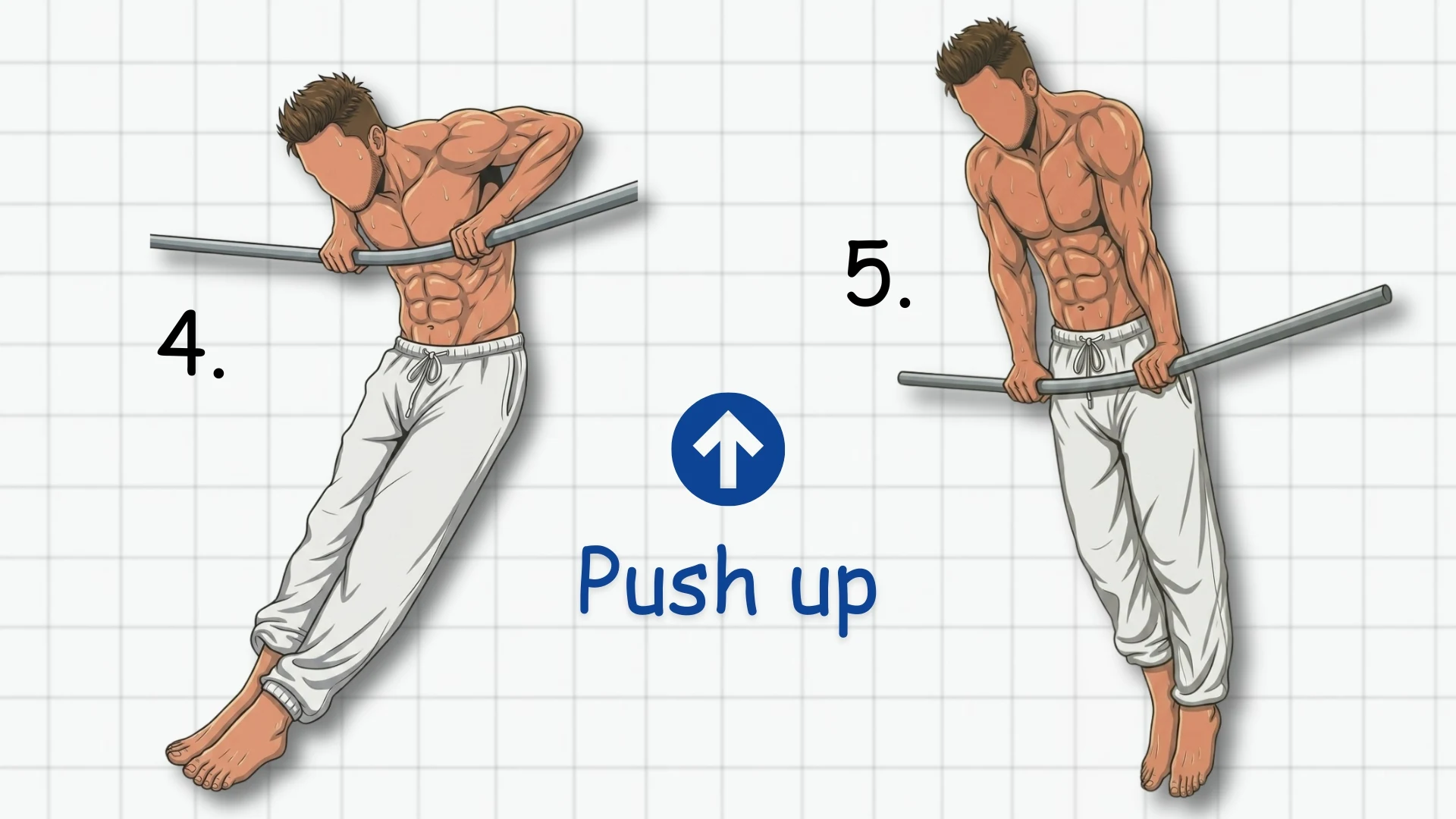
Chest low on the bar, then press until the arms lock out.
Too heavy? Negatives, or regular dips on parallel bars, close enough pattern and the same muscles.
This one is worth real attention: the deeper and stronger your straight-bar dip, the less transition you need. If you can only get your chest a little over the bar but your dip is powerful, you can start the press from an ugly low position and still finish. Dip strength buys you forgiveness everywhere else.
6. The controlled descent
Get on top of the bar however you can. Pull-over, jump, step up from something, it genuinely does not matter. Rest with your chest on the bar, squeeze your hands around it, lower yourself under control, and drop off. Then get back up and do it again.
Even if the first version is "chest on the bar, fall, try to catch yourself a bit sooner than last time", you are grooving the position. This is the same negative that builds the transition, so it pays twice.
How do you put it together?
Combine, and make it easier on yourself while you do. Chalk up if you need to. Set the overgrip. If you are using a band, jump forward into it rather than back, so the swing starts for you.
Swing, catch the moment just past the front dead point, pull hard, land in the straight-bar dip, press out. That is a muscle-up.
One warning about bands. A band can assist so much that it builds a fake pattern. You float over the bar on 20% effort, pulling to your waist with no real timing or explosiveness, and you learn a movement that does not exist without the band. Use it, but do not live in it.
How strong do you need to be for a muscle-up?
Less strong than you think, and better coordinated than you think.
My max was around four pull-ups when I got my first muscle-up. Not because I was unusually strong, but because I understood what the movement was. I have since coached people with a fifteen pull-up max who could not get one, and the reason was never strength. It was that they pulled at the front dead point instead of after it, or they had never pressed out of the bottom of a straight-bar dip in their life.
That is the honest answer to "how many pull-ups do I need". There is no number. There is a list of six pieces, and the one you are missing is the one that decides how long this takes.
If you cannot do a single pull-up yet, start with how to do a pull-up and come back once you have a few clean reps.
Judging your own timing from the inside is close to impossible, which is why filming yourself matters more here than in almost any other skill. If you want that checked frame by frame, CaliRealm is the app we built for exactly that, and 1:1 coaching is where I look at your attempt and tell you what moved too early.
What keeps most people stuck?
Five things, in the order I see them most often.
- Pulling too early. At or before the front dead point, so you travel forward instead of up. Fix the moment, not the effort.
- Training pull-ups instead of the muscle-up. Rep fifteen is not a transition. Train the six pieces.
- A neutral grip. The wrist rotation happens at the worst possible moment. Set the overgrip before you hang.
- Arching in the pull. The chest-to-bar pull-up is a different skill. This one is hollow.
- Living in the band. Too much assistance teaches a movement that does not exist once you take it away.
Does your first muscle-up have to look clean?
No. It lands like a crash. There is a knee in it. The dip is a grind. That is what a first muscle-up looks like, and it is a real muscle-up.
Chasing a strict, textbook rep before you have ever completed an ugly one is one of the fastest ways to spend a year not getting a muscle-up. Get the first one however it comes, then clean it up.
How should you train it week to week?
Do not train the muscle-up every day. Train the elements every workout.
- Tired and unmotivated but at the bar anyway? Practise the overgrip hang.
- Pushed hard yesterday and still want something? Explosive hollow pull-ups, you need that explosiveness anyway.
- Fresh? Swing timing, transitions, negatives, straight-bar dips.
Attempting the full movement every session will drive you crazy and slow you down. Attacking the pieces will get you there faster than any amount of extra pull-ups.
Muscle-up FAQ
How many pull-ups do I need before I try a muscle-up?
There is no threshold. I got mine at a four pull-up max, and I have coached people with fifteen who could not get one. Pull-up strength is one of six pieces. If your timing and your straight-bar dip are missing, more pull-ups will not fill either gap.
Is it cheating to use a knee drive or a kip?
No. The swing is part of the movement, not a shortcut around it. A kipping knee drive is how almost every first muscle-up happens, mine included. Strict muscle-ups are a separate skill you build later, on top of this one.
Why do I always end up in front of the bar?
You are pulling too early. At or before the front dead point your legs are still travelling forward, so your pull adds to that and carries you away from the bar. Wait for the instant you start swinging back, then pull.
How long does it take to learn a muscle-up?
It depends entirely on which of the six pieces you are missing. Timing can click in a few sessions once you know what you are waiting for. Straight-bar dip strength takes months if you have never pressed out of the bottom position. Find the missing piece first, then you can estimate.
Should I use a resistance band?
Yes, but briefly. A band that takes most of your bodyweight lets you float over on 20% effort and teaches a pattern that collapses without it. Use the lightest band that lets you complete the movement, and get off it as soon as you can.
Go find your dead point
Set the overgrip. Small hollow swing. Wait for the front dead point, then pull. Land in the dip and press out.
It will be ugly. Do it anyway.
Stronger than you are explosive? The strict ring muscle-up has no swing to time. It is mostly a strength exercise, and most of my female clients get it before the bar one.